
Spinal Alignment & Pelvic Placement

Spinal Alignment & Pelvic Placement : Why It Matters in Pilates — and Real Life

Since we’re in the thick of a New England winter—and many of us are spending extra time clearing heavy, wet snow—it feels like the perfect time to talk about our spines.
When we talk about “good posture,” we’re really discussing the relationship between the spine and the pelvis. Whether you’re on the reformer, mat, or simply navigating icy driveways and daily life, pelvic placement plays a major role in how efficiently your body moves—and how protected your low back feels.
What Is "Neutral Spine"?
In Pilates, neutral is often described as a place of no unnecessary tension. In this position, the spine maintains its natural curves, including a slight lumbar (low back) curve. This curve is not something to flatten or exaggerate—it’s essential.
Neutral spine is the body’s optimal shock-absorbing position, allowing forces to be distributed evenly through the joints and musculature. When the pelvis and spine are stacked well in neutral, movement becomes more efficient, balanced, and sustainable.
This is ultimately where we want to live and exercise—but it’s not always where we start.
Introducing the "Imprint"
If neutral is the goal, imprint is the support system. Imprint is a temporary, intentional tilt of the pelvis achieved by gently shortening the space between your hip bones and your ribs.
Imprint is commonly used:
When beginning a new, challenging exercise.
When the load is greater than the strength of the abdominals
If you feel any pinching or "tugging" in your low back.
Think of imprint as a supportive strategy—not a posture you live in forever, but a tool that helps build strength and awareness safely.
Neutral vs. Imprint: It’s Not Either/Or
A common misconception is that neutral is “good” and imprint is “bad.” In reality, both have a purpose.
In Pilates, we often start exercises in imprint to:
Establish abdominal engagement
Reduce strain on the low back
Build strength and control
Over time, as strength improves, we gradually work toward performing those same exercises in neutral. Just as important, we practice moving in and out of imprint, giving the body options. This ability to adjust pelvic placement is key to protecting the spine—especially when loads change.
In the studio
You’ll frequently use imprint in exercises such as:
Legs in straps - when the legs are long and reaching away from the body
Tabletop or double-leg movements
Early abdominal work where leverage is higher
In these moments, imprint allows the abdominals to do the work instead of the low back.
In daily life
These concepts don’t stay on the mat; they are survival skills for daily movement. Imprint is your best friend when the "load" of life gets heavy.
Imprint can be helpful when:
Getting out of bed
Lifting groceries or laundry
Picking something up off the floor
Rolling onto your side or transitioning from sitting to standing
Carrying a heavy bag or child
Shoveling snow (hello, New England winters)
Take shoveling for instance — by keeping the rib cage and pelvis "connected", this allows the legs and glutes to do the work while taking unnecessary strain out of the low back, keeping your spine out of the line of fire.

The Pre-Lift Checklist
Inhale: Prepare your body.
Exhale: Gently draw your hip bones toward your ribs (find your imprint).
Feel: Abdominals engage and the low back become supported
Move: Lift the shovel or groceries while maintaining that core connection.
Support first, movement second.
The Takeaway
Neutral spine is the goal—it’s efficient, balanced, and shock-absorbing. But imprint is an essential stepping stone, especially when strength is developing or demands increase.
Pilates teaches us not just where to be, but how to adapt. Learning when to support yourself with imprint and when to return to neutral builds resilience, awareness, and confidence—both in your practice and in real life.
Your spine doesn’t need rigidity.
It needs options.
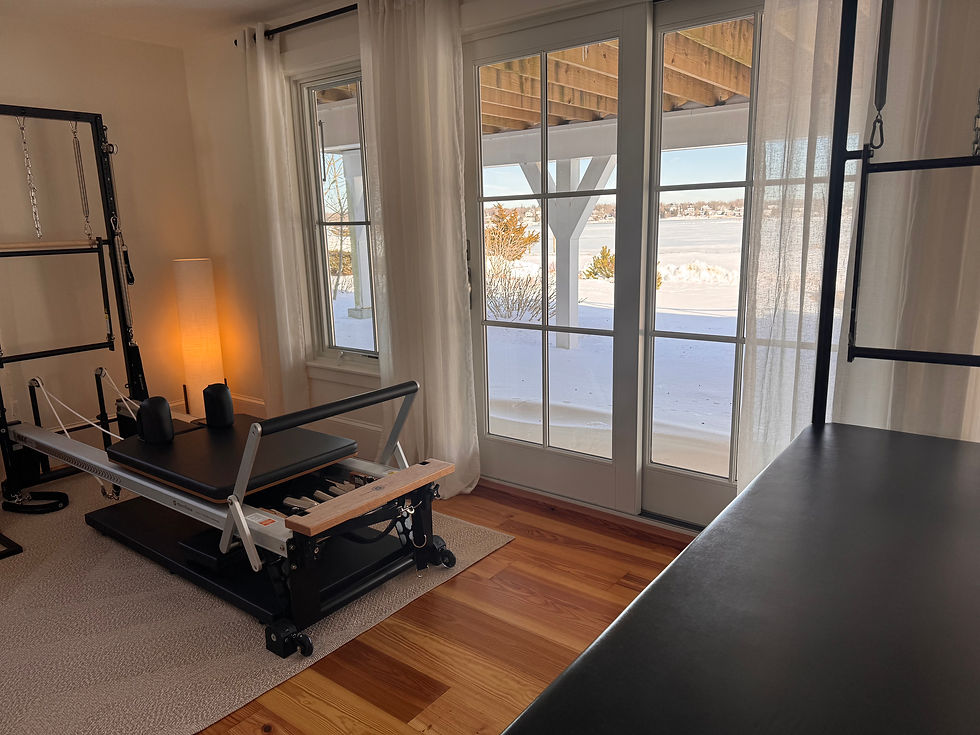
A snowy day in the studio ❄️
Ready to Move With Purpose?
At Flo Haven Studio, we create personalized Pilates experiences designed to support your unique goals — whether you’re returning to movement, recovering from injury, or simply craving a more connected way of living.
Book your complimentary 30-minute consultation today and take the first step toward moving (and living) with greater awareness, balance, and breath.

Comments